Executive Summary: The Cross-Country Commute Matrix
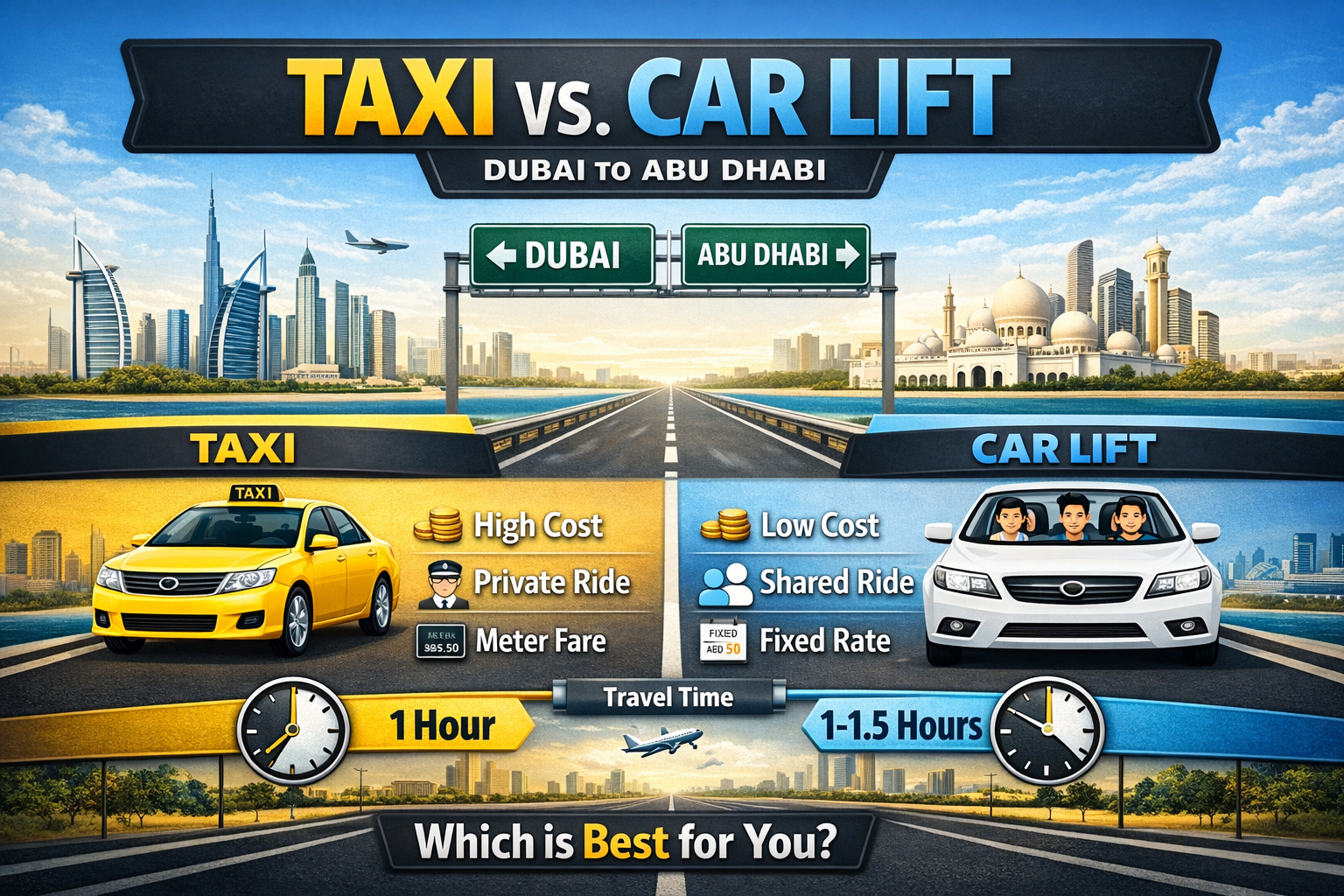
Before diving into the granular mechanics of sharing a daily 140-kilometer journey across the UAE, we need a baseline. I spent seven years running the E11 gauntlet alone before realizing the sheer financial and psychological hemorrhage it caused. Below is the comparative matrix mapping solo driving against a properly structured car pool Dubai to Abu Dhabi arrangement. The data reflects a standard 22-day working month using a mid-size sedan.
| Commute Metric | Solo Driving (Monthly) | Car Pool (3 Passengers) | Net Difference |
|---|---|---|---|
| Fuel (Super 98) | 1,850 AED | 462 AED (Shared) | Save 1,388 AED |
| Tolls (Salik & Darb) | 352 AED | 88 AED (Shared) | Save 264 AED |
| Vehicle Depreciation | High (3,000km/mo) | Moderate (Shared driving duties) | Extended vehicle lifespan |
| Commuter Fatigue | Severe | Minimal | Immeasurable productivity gain |
We need to dismantle the romanticized idea of the inter-emirate road trip. Doing it once on a weekend is a scenic drive. Doing it at 6:30 AM on a Tuesday while fighting heavy commercial traffic near Ghantoot is a battle of attrition. I discovered early on that splitting this burden was not just an economic hack; it was a survival strategy.
The Intricate Legalities of a Car Pool Dubai to Abu Dhabi
You cannot simply throw four strangers into a Nissan Altima and charge them a daily rate. The UAE has stringent regulations governing passenger transport. I learned this the hard way in 2018 when a well-meaning colleague and I were questioned near the Shahama checkpoint. We were splitting gas money, but our arrangement looked suspiciously like an unlicensed taxi operation to an outside observer.
Operating an illicit transport service carries catastrophic fines. It is vital to understand the distinction between cost-sharing and profit generation. Under the purview of the Roads and Transport Authority (RTA), residents are permitted to share rides provided the financial exchange strictly covers the operational costs of the journey—fuel, tolls, and standard parking fees. The moment you cross into generating a profit, you violate the law.
Similarly, the jurisdiction shifts once you cross the border. The Integrated Transport Centre (ITC) manages the transport ecosystem within the capital. Their mandates parallel Dubai’s: private carpooling amongst colleagues and friends is acceptable, but commercializing your private vehicle without commercial licensing is strictly forbidden. This regulatory tightrope is exactly why informal WhatsApp groups often collapse under the weight of liability and logistical anxiety.
Financial Autopsy: The Real Cost of the E11 Corridor
Let us look at the raw mathematics. Most commuters vastly underestimate their actual expenditure. They look at the fuel gauge and stop there. If you commute from Dubai Marina to the Abu Dhabi Global Market (ADGM), you are covering roughly 120 kilometers each way. That totals 240 kilometers daily, yielding an average of 5,280 kilometers in a standard working month.
Assuming your vehicle achieves a fuel economy of 9 liters per 100 kilometers, you are burning 475 liters of fuel monthly. At an average of 3.00 AED per liter, your baseline fuel cost sits at 1,425 AED. But fuel is merely the entry ticket.
Tolls, Tires, and Hidden Attrition
Every journey triggers a cascade of secondary costs. Passing the Safa and Barsha Salik gates deducts 8 AED. Entering Abu Dhabi during peak morning hours triggers the Darb toll, adding another 4 AED. The return trip mimics this taxation. You are bleeding 24 AED daily just in road use fees. Multiply that by 22 days, and you forfeit 528 AED.
Then comes the mechanical reality of the UAE climate. Asphalt temperatures in July exceed 60 degrees Celsius. Sustaining speeds of 140 km/h on superheated tarmac accelerates tire degradation exponentially. A premium set of tires, which usually lasts 60,000 kilometers, will need replacing in less than a year on this route. Routine maintenance intervals compress; you will find yourself booking oil changes every six weeks. Factoring in depreciation—adding 60,000 kilometers annually destroys the resale value of most vehicles—your true monthly commuting cost easily exceeds 4,000 AED.
Sharing these exact costs among three or four reliable individuals instantly neutralizes the financial damage. A well-organized car pool Dubai to Abu Dhabi route effectively gives you a significant annual salary bump just in realized savings.
Optimizing Your Route: Strategy Over Speed
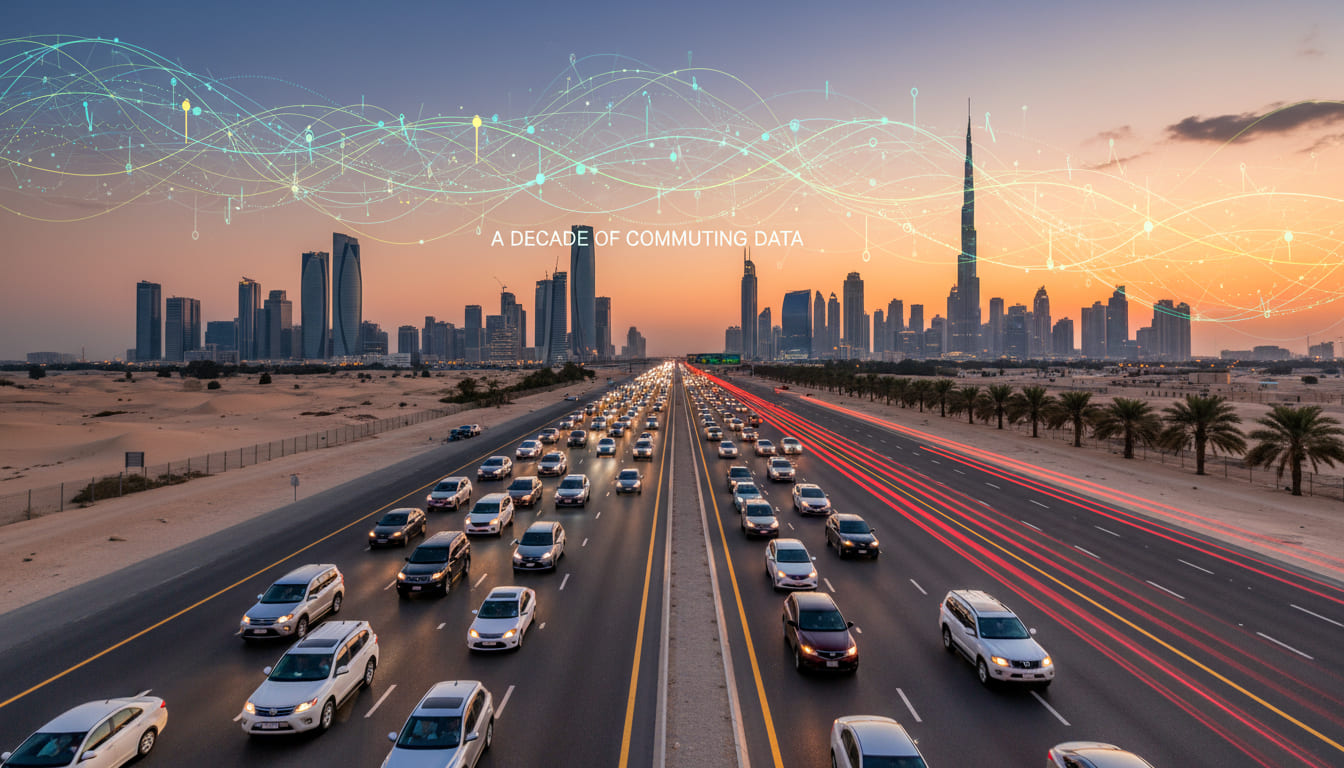
Veterans of the inter-emirate run know that distance is not the enemy; congestion patterns are. You essentially have three vascular arteries connecting the two cities, each with distinct psychological and physical profiles.
The E11 (Sheikh Zayed Road / Sheikh Maktoum Bin Rashid Road)
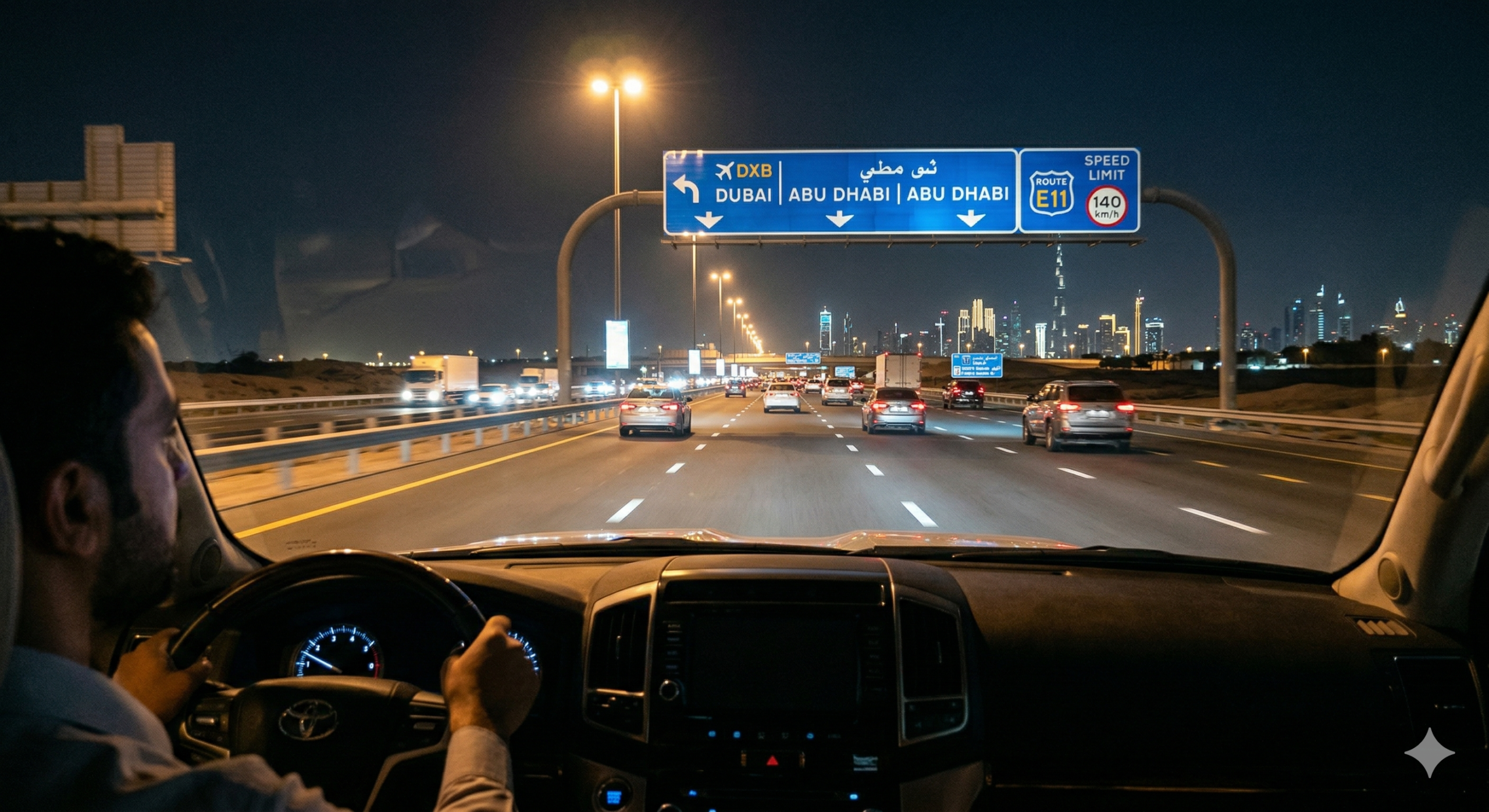
This is the default artery. It offers a direct line of sight from the heart of Dubai into the capital. However, it is a volatile corridor. The transition zone near Ghantoot—where the speed limit shifts and the radar configurations change—creates phantom traffic jams. Daily commuters must possess an innate understanding of these bottleneck rhythms. The absolute speed limit drops buffer zones depending on the emirate; Dubai enforces a 100 km/h limit with a 20 km/h buffer, while Abu Dhabi imposes a strict 140 km/h limit with zero buffer. Relying on cruise control without acute situational awareness is an expensive mistake.
The E311 (Sheikh Mohammed Bin Zayed Road)
Moving inland, the E311 serves as an exceptional alternative when coastal fog rolls in during the winter months. Fog on the E11 is perilous. The E311 generally experiences slightly lighter heavy-truck traffic during peak passenger hours, though the entry vectors back into Abu Dhabi island require strategic navigation via the E10 or Yas Island exits. If your carpool destination is Khalifa City or Yas Island, this route is mathematically superior.
The E611 (Emirates Road)
Deep inland, the E611 is the quietest, yet longest route. It demands an additional 20 to 30 kilometers of driving, but it virtually guarantees uninterrupted cruise control. For a car pool Dubai to Abu Dhabi setup originating from outer communities like Arabian Ranches or Town Square, the E611 bypasses the morning gridlock of central Dubai entirely. The fuel penalty of the extra distance is frequently offset by the fuel savings of not idling in stop-and-go traffic.
Establishing a Trust-Based Transit Network
Coordination destroys most carpool ambitions. Managing four different morning routines, varying corporate exit times, and the inevitable “I am running five minutes late” text messages can turn a cost-saving measure into a daily stressor. I spent two years attempting to manage a rotation via shared spreadsheets. It was miserable.
Technology bridges this trust and logistical gap. You need dedicated platforms that hold users accountable. This is where modern infrastructure steps in. For example, utilizing innovative ride-sharing solutions completely automates the scheduling, the financial splitting, and the critical vetting process. Removing the awkwardness of asking colleagues for their share of the toll money preserves professional relationships. A neutral third-party platform acts as the arbiter of punctuality and payment.
The Unspoken Etiquette of a Car Pool Dubai to Abu Dhabi
Sharing an enclosed cabin for three hours a day requires diplomacy. A vehicle is a micro-climate, and minor irritants compound over thousands of kilometers. Establishing the ground rules on day one prevents resentment by month three.
The Climate Control Treaty: The UAE summer is unforgiving. One passenger might prefer a frosty 19 degrees, while another shivering in the back seat wants 24 degrees and minimal fan speed. The driver typically acts as the supreme commander of the thermostat, but equitable rotation of seating assignments usually resolves these disputes. The front passenger seat receives the brunt of the AC; the rear seats often lag. Rotate daily.
Acoustic Boundaries: The morning commute is sacred time. Some professionals use the hour to mentally prepare for boardroom battles; they require silence. Others need a high-BPM playlist to stay awake. In our last project team carpool, we instituted a strict “headphones preferred” policy. If someone wanted to listen to a podcast, they used AirPods. The car audio was reserved for low-volume, neutral background music. Never assume your love for heavy metal or intense political talk radio is shared.
Punctuality Protocols: This is the executioner of carpools. A five-minute delay at the pickup point in Jumeirah Village Circle translates to a twenty-minute delay arriving at the Corniche because you miss the narrow window before the E11 congests. Implement a hard-departure rule. If the departure time is 6:15 AM, the vehicle shifts into drive at 6:15 AM. A straggler is left behind. It sounds ruthless, but without it, the entire system collapses.
Olfactory Considerations: Strong perfumes, heavy colognes, or traditional oud are deeply embedded in regional culture. However, in a sealed, air-conditioned box hurtling down the highway, strong scents cause nausea and headaches for sensitive passengers. A neutral scent policy is highly recommended.
The Insurance Matrix: Protecting Your Passengers
Very few commuters read the fine print of their motor vehicle insurance policies. If you are operating a dedicated car pool Dubai to Abu Dhabi arrangement, you must verify your passenger liability coverage. Comprehensive insurance in the UAE generally covers passengers in the event of an accident, but this coverage can be voided if the insurer determines the vehicle was being used for unauthorized commercial purposes.
This reiterates the importance of strict cost-sharing versus profit-making. If you are involved in a collision near Al Samha and investigators discover you were charging passengers 100 AED per head—which exceeds standard operational costs—your insurance provider has legal grounds to reject the claim. Ensure your policy includes premium passenger cover and stick rigidly to transparent, non-profit cost division.
Evaluating Vehicle Archetypes for the Long Haul
The machinery matters. Attempting this commute in a subcompact hatchback with minimal sound insulation is a recipe for sensory fatigue. Road noise at 140 km/h is highly exhausting over a 90-minute stretch.
The Mid-Size Sedan (Toyota Camry, Honda Accord): These are the workhorses of the route. They offer adequate sound deadening, excellent fuel economy (especially hybrid variants), and sufficient rear legroom. They represent the optimal balance of cost and comfort.
The Full-Size SUV (Nissan Patrol, Toyota Land Cruiser): Culturally dominant and incredibly safe, these vehicles command respect on the E11. Lane discipline around you improves dramatically when driving a large SUV. However, the fuel penalty is severe. You will burn almost double the fuel compared to a hybrid sedan, drastically reducing the economic benefits of the carpool.
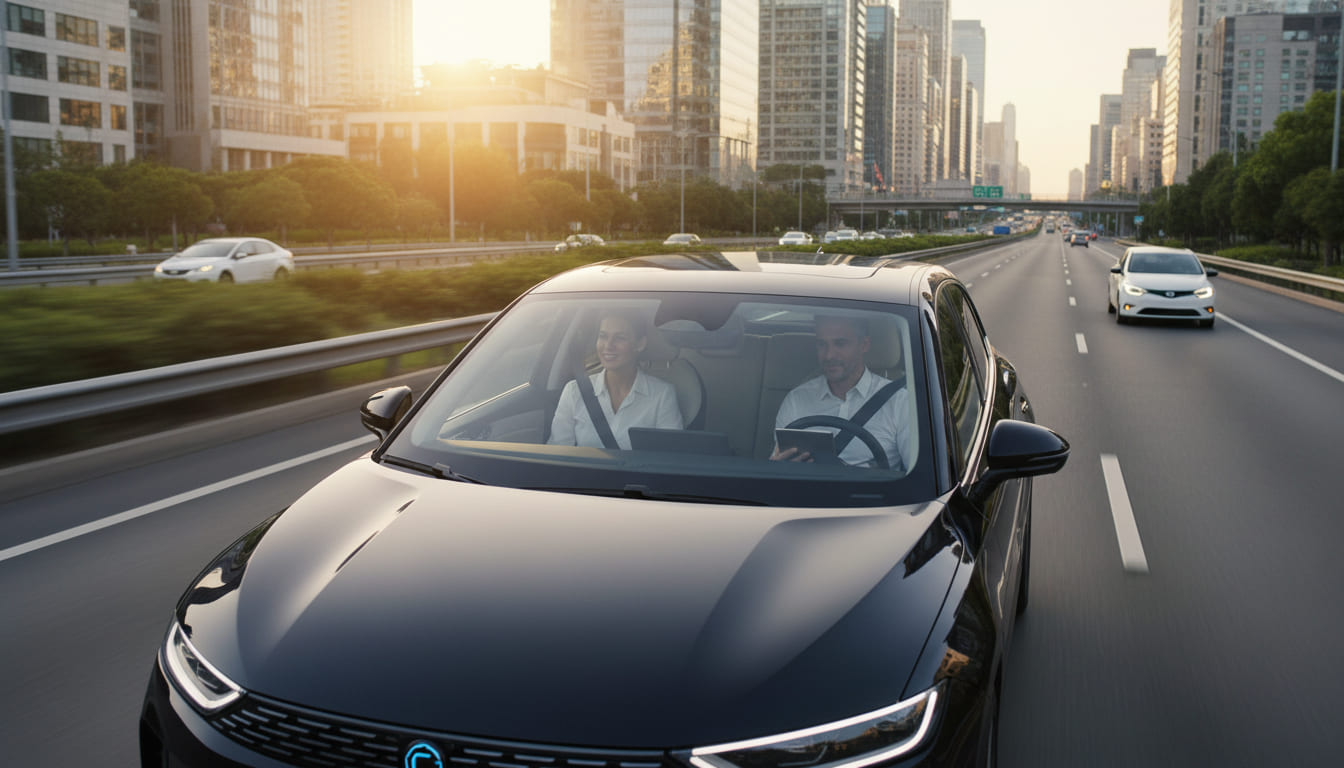
The Electric Vehicle (Tesla Model 3/Y, Polestar 2): EVs have fundamentally rewritten the economics of the cross-country commute. Charging an EV at home overnight to full capacity costs a fraction of a tank of Super 98. Furthermore, the Autopilot and advanced lane-keeping assist features reduce driver fatigue to near zero. A car pool Dubai to Abu Dhabi running on an EV platform is currently the most economically efficient transport model in the country, assuming you have reliable home charging infrastructure.
Environmental Dividends and Corporate Responsibility
Beyond personal finance, we must confront the ecological footprint of our mobility. A solo commuter driving a gasoline sedan between the emirates emits roughly 11.5 metric tons of CO2 annually. That is an astonishing volume of localized emissions for a single individual.
When four people consolidate into one vehicle, that carbon footprint is slashed by 75% per capita. This aligns directly with the directives outlined by the Ministry of Energy and Infrastructure, which champions sustainable urban mobility and greenhouse gas reduction. Forward-thinking corporations in the UAE are now actively encouraging their employees to form transit pods, not just to reduce parking constraints at corporate headquarters, but to integrate these carbon savings into their annual ESG (Environmental, Social, and Governance) reporting.
I have consulted for several firms in ADGM that now offer preferential VIP parking spots exclusively to vehicles arriving with three or more employees. Small behavioral nudges like this radically shift commuter habits.
Emergency Protocols on the Open Highway
Even the most meticulously maintained vehicle will eventually suffer a failure. A blowout at high speed or a sudden radiator leak in the summer heat is a serious incident. Your carpool group needs an agreed-upon emergency protocol.
First, never attempt to change a tire on the left shoulder of the E11. The slipstream from heavy trucks passing at 100 km/h is enough to pull a person into traffic. If a failure occurs, limp the vehicle to the right-hand shoulder or, ideally, an exit ramp. Keep reflective triangles and high-visibility vests in the trunk. The group must decide beforehand how to handle alternative transport if the vehicle is immobilized. Who calls the recovery truck? Do the passengers immediately hail a regional taxi to ensure they make their morning meetings, leaving the driver to handle the tow? Having this conversation in a calm office environment is vastly superior to arguing on the side of a scorching highway.
The Psychological Transition Zone
Commuting is a liminal space. It is the buffer between domestic life and professional warfare. When you drive alone, that space is solitary confinement. You ruminate on office politics or stress about evening errands.
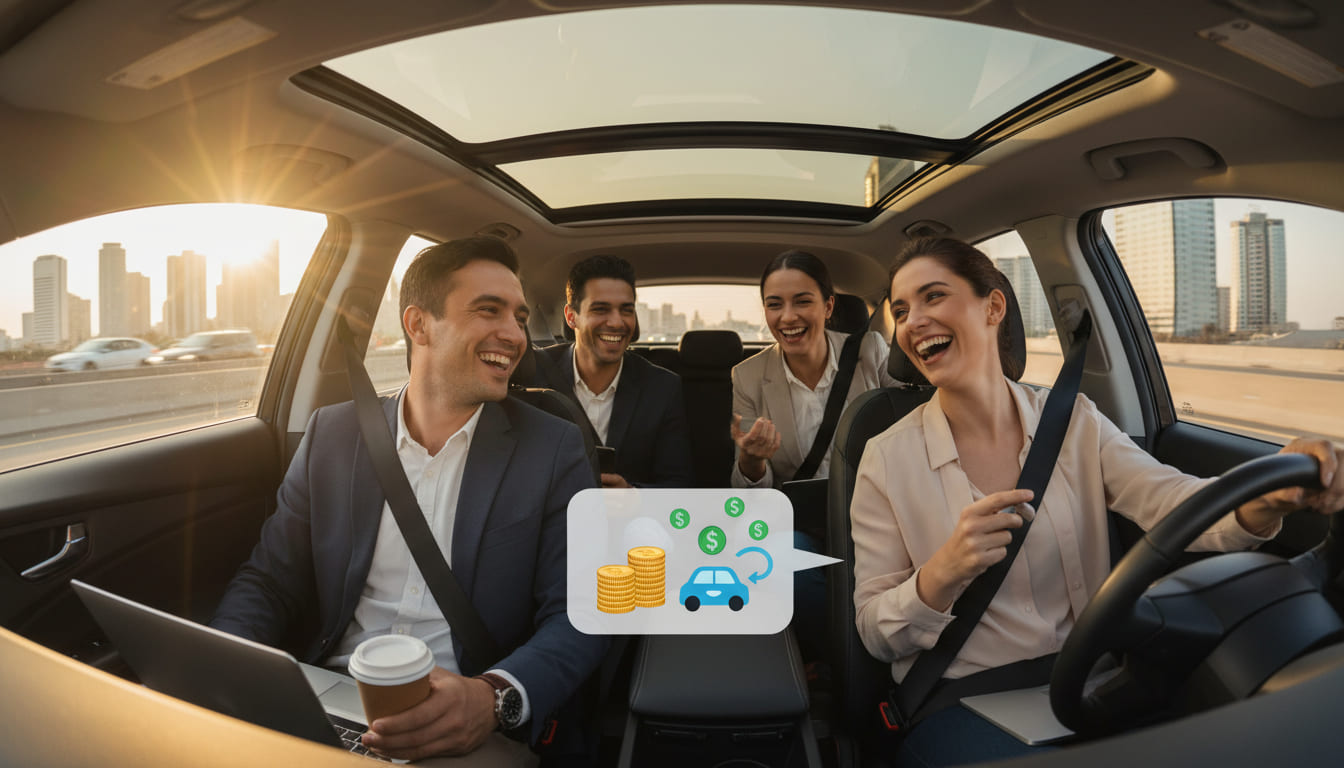
A well-curated carpool changes this psychological dynamic. It introduces structured socialization. I found that the 90 minutes spent with my colleagues in the car allowed us to unofficially “debrief” the day before we even reached our respective homes. By the time I stepped through my front door in Dubai, the stress of the Abu Dhabi office had entirely dissipated. The highway became a decompression chamber rather than an added stressor. The camaraderie forged in those vehicles often outlasts the employment contracts that brought us together.
Navigating Corporate Shifts and Hybrid Work
The post-2020 landscape permanently altered how we view the office. With the rise of hybrid schedules, the daily five-day commute is less common, but the three-day mandate is prevalent. This makes securing a consistent car pool Dubai to Abu Dhabi slightly more complex, as schedules misalign. Passenger A might work Tuesday through Thursday in the office, while Passenger B works Monday, Wednesday, and Friday.
This fragmented scheduling requires dynamic routing and flexible commitments. It pushes us further away from informal handshake agreements and heavily toward algorithmic matching platforms. You need a system that allows you to book a seat on a granular, per-day basis rather than committing to a rigid monthly contract. Flexibility is the new currency of inter-city transit.
The Future Horizon of Mobility
We are standing on the precipice of a transport revolution in the UAE. The imminent rollout of passenger services on the Etihad Rail network will undoubtedly shift the dynamic of the coastal commute. Trains moving at 200 km/h will offer a compelling alternative to the E11.
However, rail networks solve the macro-commute, not the micro-commute. A train will transport you from a central hub in Dubai to a central hub in Abu Dhabi. You still face the “last mile” problem. How do you get from your villa in Jumeirah Park to the train station, and then from the Abu Dhabi station to your exact office building? Carpooling will evolve from a cross-country endeavor into localized hub-feeder networks. The infrastructure we build now—the habits of sharing space, splitting costs, and utilizing smart routing platforms—will seamlessly adapt to feed these high-speed rail terminals.
Until that network is fully operational, the asphalt remains our primary conduit. Surviving and thriving on that conduit requires moving away from the isolated, expensive, and exhausting solo drive. It requires embracing shared logistics, leveraging robust digital platforms, and applying a deeply strategic mindset to those 140 kilometers. The math heavily favors the collective. Make the switch, optimize your mornings, and reclaim those lost hours.