Future of Monthly Travel: Are You Ready to Switch to Car-Lift?
Remember the days when your “monthly travel” involved a predictable routine? Perhaps it was the solo drive to visit family a few states over, the long commute to a regional office, or those regular weekend getaways. For many, these recurring journeys have become a significant part of life, often accompanied by rising costs, environmental concerns, and the sheer mental fatigue of navigating the open road alone. But what if there was a smarter, more connected way to undertake these regular trips? What if the Future of Monthly Travel wasn’t about more individual cars, but about more shared experiences? Welcome to the world of car-lifting, an often-overlooked solution that could fundamentally redefine how you approach your long-distance journeys.
The Shifting Landscape of Monthly Travel: Why Change is on the Horizon
The way we move around is in constant flux, and the concept of “monthly travel” is no exception. We’re not just talking about the daily grind to work; we’re referring to those longer, recurring trips that happen once or twice a month. Think about the college student heading home for the weekend, the professional commuting to a satellite office, the grandparent visiting their grandkids, or the adventurer regularly escaping to a favorite remote spot. These aren’t one-off vacations; they’re integral, often essential, parts of many people’s lives.
For years, the default for these journeys has been the personal car, or perhaps a bus or train if the route aligned. However, a growing demand for more flexible, cost-effective, and sustainable transportation options is bubbling to the surface. People are seeking alternatives that align with modern values of sharing, community, and environmental responsibility. This is where car-lift steps in – a promising, often overlooked alternative that could very well be a cornerstone of the Future of Monthly Travel, offering a fresh perspective on how we connect with destinations and each other.
Why Our Current Monthly Travel Habits Need a Rethink
Let’s be honest, those regular long drives, while sometimes a cherished solitude, often come with a hidden baggage train of downsides. Our traditional approach to monthly travel is increasingly showing its cracks, prompting a collective desire for smarter solutions.
Rising Costs & Wear and Tear
- This is often the most immediate and painful point for many. Fuel prices fluctuate, but rarely go down significantly. Add in tolls, routine maintenance, unexpected repairs, tire wear, and the sheer depreciation of your vehicle, and those “cheap” monthly trips suddenly become a substantial financial burden. A 500-mile round trip, even with a fuel-efficient car, can easily cost over $100 just in gas, not to mention the hidden costs that chip away at your wallet over time. As a seasoned traveler, I’ve seen countless friends lament the “car expenses” line item in their budget, often directly tied to their regular long-distance commitments.
Environmental Impact
- We’re all becoming more aware of our carbon footprint, and rightly so. A single-occupancy vehicle, especially on long journeys, is a significant contributor to greenhouse gas emissions. As individuals, we often feel powerless to make a difference, but collectively, our travel choices have a profound impact. The desire for greener travel solutions isn’t just a trend; it’s a necessity, and consciously choosing options that reduce our environmental impact is a powerful step towards a more sustainable Future of Monthly Travel.
Stress & Isolation
- While some enjoy the peace of a solo drive, for many, long hours behind the wheel are synonymous with mental fatigue, boredom, and even loneliness. Navigating traffic, staying alert, and dealing with unexpected delays can be incredibly draining. The isolation of being alone in a car for hours on end means missed opportunities for conversation, connection, or even just sharing the driving load. I recall countless times wishing for a co-pilot on a particularly grueling stretch of highway, not just for company, but for the shared responsibility.
Inefficiency
- Look around next time you’re on the highway. How many cars do you see with just one person inside? The vast majority. This represents an enormous inefficiency – empty seats, underutilized resources, and unnecessary congestion. Traditional modes of travel often operate on a “one person, one car” model, which is simply unsustainable and inefficient in the long run. There’s a clear need for smarter, shared solutions that make the most of available resources.
Understanding Car-Lift: Your New Monthly Travel Companion
So, what exactly is “car-lift,” and how does it fit into the equation? It’s not a new concept, but its modern application, facilitated by technology, is truly transformative.
What is Car-Lift?
- At its core, car-lifting (often interchangeably called ridesharing or carpooling in a long-distance context) is a pre-arranged, shared journey for regular or recurring long-distance travel. It’s about a driver with available seats offering them to riders who are heading along the same route, typically on a recurring basis. The key differentiator here is the pre-arrangement and recurring nature, setting it apart from spontaneous, short-distance ride-hailing services.
- How It Works: The typical process is straightforward. A driver planning a regular trip (e.g., from City A to City B every first weekend of the month) posts their itinerary on a dedicated car-lift platform. Riders looking to travel that same route on a similar schedule browse available rides, find a match, and book a seat. Costs (primarily fuel and tolls) are shared among the occupants, making it significantly cheaper for everyone involved. Communication often happens through the platform, allowing drivers and riders to agree on details before the journey.
Key Distinctions
- It’s important to differentiate car-lift from general carpooling or even hitchhiking.
- Carpooling: Often implies a daily commute within a city or metropolitan area, usually among colleagues or neighbors. Car-lift typically refers to longer, inter-city or inter-state travel.
- Hitchhiking: Traditionally involves flagging down strangers by the roadside with no pre-arrangement, verification, or shared cost agreement. Car-lift, in its modern form, is planned, often facilitated by platforms with user profiles and reviews, and involves a transparent cost-sharing model. It’s about mutual benefit and planned convenience, not chance encounters.
Common Use Cases
-
- Students commuting home for weekends: A classic example. Instead of expensive train tickets or a long, solo drive, students can share a ride and split costs.
- Professionals traveling to regional offices: Many companies have distributed teams. A monthly visit to headquarters becomes far more economical and social with car-lift.
- Individuals visiting family regularly: Whether it’s parents visiting adult children or vice-versa, car-lift provides a sustainable and cost-effective way to maintain those important connections.
- Friends or enthusiasts heading to recurring events: Think monthly conventions, hobby meet-ups, or even just regular trips to a favorite hiking spot that’s a few hours away.
The Perks of Piling In: Benefits of Embracing Car-Lift for Regular Journeys
Switching to car-lift isn’t just about trying something new; it’s about unlocking a host of tangible benefits that can dramatically improve your monthly travel experience.
Significant Cost Savings
- This is often the biggest draw. Imagine dividing the cost of fuel and tolls by two, three, or even four people. For a driver, it significantly offsets their expenses, often making the trip almost free. For riders, it’s typically far cheaper than public transport (especially last-minute bookings) and a fraction of the cost of driving their own vehicle. Over a year, these savings can amount to hundreds, if not thousands, of dollars. One colleague of mine, who used to spend nearly $300 a month on gas and tolls for her regular trip to her parents, cut that down to less than $100 by consistently car-lifting. That’s real money back in your pocket!
Reduced Environmental Footprint
- Fewer cars on the road mean lower overall emissions. By choosing car-lift, you’re directly contributing to a reduction in carbon dioxide, nitrogen oxides, and other pollutants. It’s a simple, effective way to make your regular journeys more sustainable and align with a greener Future of Monthly Travel. Every shared ride is one less car adding to congestion and pollution.
Enhanced Social Connection & Networking
- Long drives can be boring. Car-lift transforms that into an opportunity. You get to meet new people from diverse backgrounds, share stories, and even build valuable connections. I’ve heard countless tales of riders and drivers discovering shared interests, forming friendships, and even finding business contacts during these journeys. It’s a chance to break out of your bubble and engage with the world beyond your headphones.
Stress Reduction & Convenience
-
- For riders: No driving fatigue, no navigation stress, no worrying about parking. You can relax, read a book, catch up on work, or simply enjoy the scenery.
- For drivers: While you’re still driving, having company can make the journey feel shorter and less monotonous. Plus, the shared financial burden can significantly reduce the stress associated with travel costs. It’s like having a co-pilot, even if they’re just there for conversation.
Increased Flexibility for Specific Routes
- Unlike rigid public transport schedules that might involve multiple transfers or indirect routes, car-lift often provides more direct, door-to-door (or close to it) options. Drivers typically set routes based on their personal needs, which can be far more convenient for specific destinations not well-served by buses or trains. This flexibility is a game-changer for many who find public transport inconvenient for their specific monthly travel needs.
Navigating the Road Ahead: Challenges and Considerations for Car-Lifters
While the benefits are compelling, it’s crucial to approach car-lifting with an understanding of its potential challenges and how to mitigate them. Like any shared experience, it requires a bit of planning and consideration.
Safety and Trust
- This is, understandably, the most significant concern for many. Traveling with strangers can feel daunting. The key here is to always use verified platforms with robust user reviews, identity checks, and safety features. Reputable platforms often have:
- Verified profiles: Linking to social media or requiring ID verification.
- Rating systems: Allowing users to review each other after each trip.
- Emergency features: In-app buttons or dedicated support lines.
- Trust your gut: If a profile seems suspicious or communication feels off, do not proceed. It’s always better to err on the side of caution. As someone who’s facilitated many shared trips, I can’t stress enough the importance of platforms that prioritize user safety.
Reliability and Punctuality
- Life happens. Last-minute cancellations or delays can occur, which can be frustrating, especially if you have a tight schedule.
- Mitigation: Choose drivers/riders with strong reliability ratings. Communicate clearly about punctuality expectations before the trip. Always have a backup plan (e.g., knowing alternative public transport options, or having a contact for another car-lift). Over-communication is always better than under-communication.
Comfort and Compatibility
- You’ll be sharing a confined space for several hours. Aligning expectations regarding music preferences, conversation levels, desired stops, and general travel etiquette is vital for a pleasant journey.
- Tips: Don’t be afraid to ask questions before booking: “Do you mind if I listen to an audiobook with headphones?” or “How often do you usually stop for breaks?” Platforms often allow drivers to specify preferences (e.g., “quiet ride,” “chatty,” “no smoking”).
Legal and Insurance Aspects
- This is a crucial, often overlooked area.
- Insurance: Most personal car insurance policies are designed for personal use, not commercial transportation. While car-lifting where only shared costs (fuel, tolls) are exchanged is generally considered non-commercial, it’s vital to check with your specific insurance provider to understand their stance. Some policies might have clauses that could invalidate coverage if an accident occurs while sharing a ride for a fee.
- Local Regulations: Be aware of any local or state regulations regarding non-commercial ride-sharing. While widely accepted, specific rules can vary. Most reputable platforms operate within these guidelines, but it’s good to be informed. Always consult with your insurance provider or a legal professional for specific advice related to your circumstances.
Luggage and Pet Policies
- Clarify these specifics upfront. Don’t assume there’s unlimited trunk space or that your furry friend is welcome. Drivers often specify these details in their listings, but if not, always ask. A common mistake I’ve seen is someone showing up with three large suitcases for a compact car ride, leading to awkward situations.
Real Stories from the Road: Car-Lift in Action
To truly appreciate the power of car-lift, let’s look at some real-world scenarios that embody the spirit of the Future of Monthly Travel. These aren’t just hypothetical benefits; they’re lived experiences.
The Student’s Success Story
- Meet Sarah, a university student studying three hours away from her hometown. Before car-lift, her monthly trips home were a financial drain, either on expensive train tickets or the wear-and-tear of her old sedan. “I started using a car-lift app last year,” she recounts. “Now, I usually find a ride for half the price of the train, and I’ve met some really interesting people. One driver, a graphic designer, even gave me advice on my portfolio! It’s not just about saving money; it’s about making the journey part of the experience.” Sarah often shares her trip details with her parents via the app’s sharing feature, giving them peace of mind.
The Remote Professional’s Commute
- John, a software engineer, works remotely but needs to visit his company’s head office in another city once a month for team meetings. Driving alone was a 4-hour slog each way. “I saw an internal company notice about a car-lift group,” John explains. “Now, I regularly share a ride with two other colleagues who live nearby. We rotate driving, or one person consistently drives and we split the gas. It’s fantastic for networking, we often brainstorm during the drive, and it turns travel time into productive or social time. Plus, our company even reimburses a portion of the shared travel costs, recognizing the efficiency.”
The Eco-Conscious Explorer
- For Maria, a passionate hiker, her monthly pilgrimage to a national park two hours away was a personal joy but also a point of environmental guilt. “I love being in nature, but driving alone felt hypocritical,” she shares. “I found a car-lift group specifically for outdoor enthusiasts. Now, I regularly connect with other hikers heading to the same trails. We share tips, plan routes, and car-lift together. It aligns perfectly with my sustainable lifestyle, and it’s great to have company on the less-traveled roads.”
Data-Backed Trends
- It’s not just anecdotal. Reputable car-sharing platforms like BlaBlaCar (a major player in long-distance car-lift) consistently report significant growth in recurring, long-distance ride requests. Their data shows millions of users actively engaging in this model, confirming its increasing popularity and viability as a mainstream travel option. The numbers validate what these personal stories tell us: car-lift is not just a niche; it’s a growing movement.
Overcoming Hesitations
- These individuals all initially had similar concerns about safety and reliability. They overcame them by:
- Starting small: Choosing short, busy routes first.Future of Monthly Travel
- Thorough vetting: Reading every review, checking profiles carefully.
- Pre-trip communication: Asking all their questions before committing.
- Trusting the platform’s features: Using secure payment, in-app messaging, and emergency contacts.
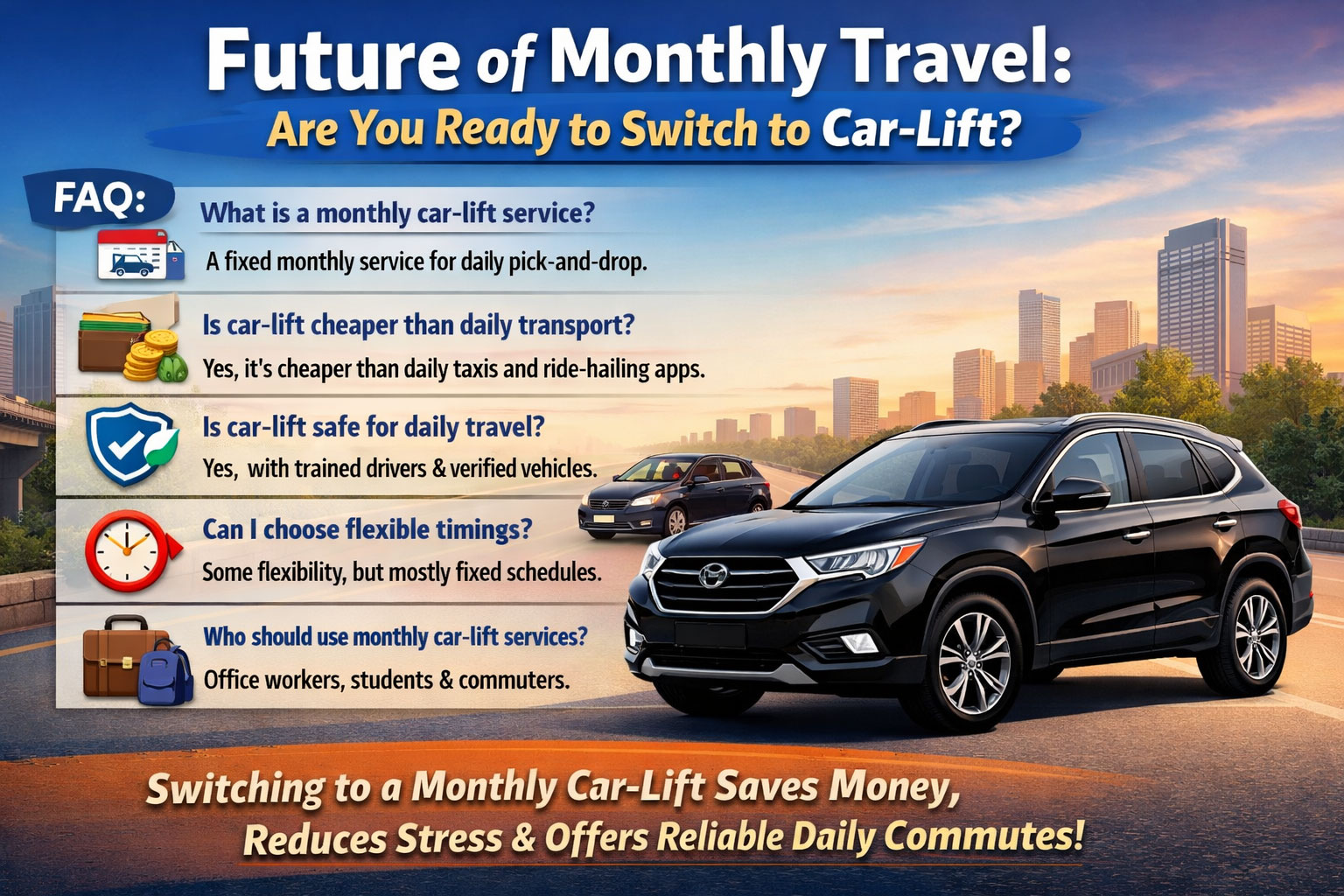
FAQs – Future of Monthly Travel: Are You Ready to Switch to Car-Lift?
1. What is a monthly car-lift service?
A monthly car-lift service is a shared or private transport solution where you pay a fixed monthly fee for daily pick-and-drop between locations, such as home to office.
2. Is car-lift cheaper than daily transport?
Yes, car-lift services are usually more affordable than daily taxis or ride-hailing apps because costs are shared and fixed monthly plans reduce daily expenses.Future of Monthly Travel
3. Is car-lift safe for daily travel?
Most professional car-lift services offer trained drivers, verified vehicles, and fixed routes, making them a safe and reliable option for regular commuters.
4. Can I choose flexible timings in a car-lift service?
Many providers offer flexible schedules, but fixed timing plans are more common to ensure efficiency and consistency for all passengers.
5. Who should use monthly car-lift services?
Office workers, students, and daily commuters who travel long distances regularly can benefit the most from affordable and convenient car-lift solutions.
Conclusion
The future of daily commuting is shifting toward smarter, more cost-effective solutions—and monthly car-lift services are leading the way. With rising fuel costs, traffic congestion, and the need for reliable transportation, switching to a car-lift is a practical choice for modern travelers. It not only saves money but also offers comfort, consistency, and peace of mind. If you’re looking for a hassle-free daily travel solution, now is the perfect time to make the switch to a monthly car-lift service.
Don’t wait—schedule your car lift today and experience a seamless ride between Dubai and Abu Dhabi. For more Contact Us or connect Direct via WhatsApp.
For more insights and tips on safe, affordable, and reliable transport services, visit our other articles and stay updated with the latest guides and expert advice.