Comparing Dubai to Abu Dhabi Travel Times, Typical Costs, and Logistics
Crossing between the UAE’s two biggest hubs sounds simple on paper, but picking the wrong ride can turn a quick day trip into a slog. Whether you are heading to a morning meeting in the capital or catching a flight from Zayed International, your priorities—budget versus raw convenience—dictate the right wheels. Below, we break down how each transit option actually behaves on the asphalt so you can book without second-guessing.
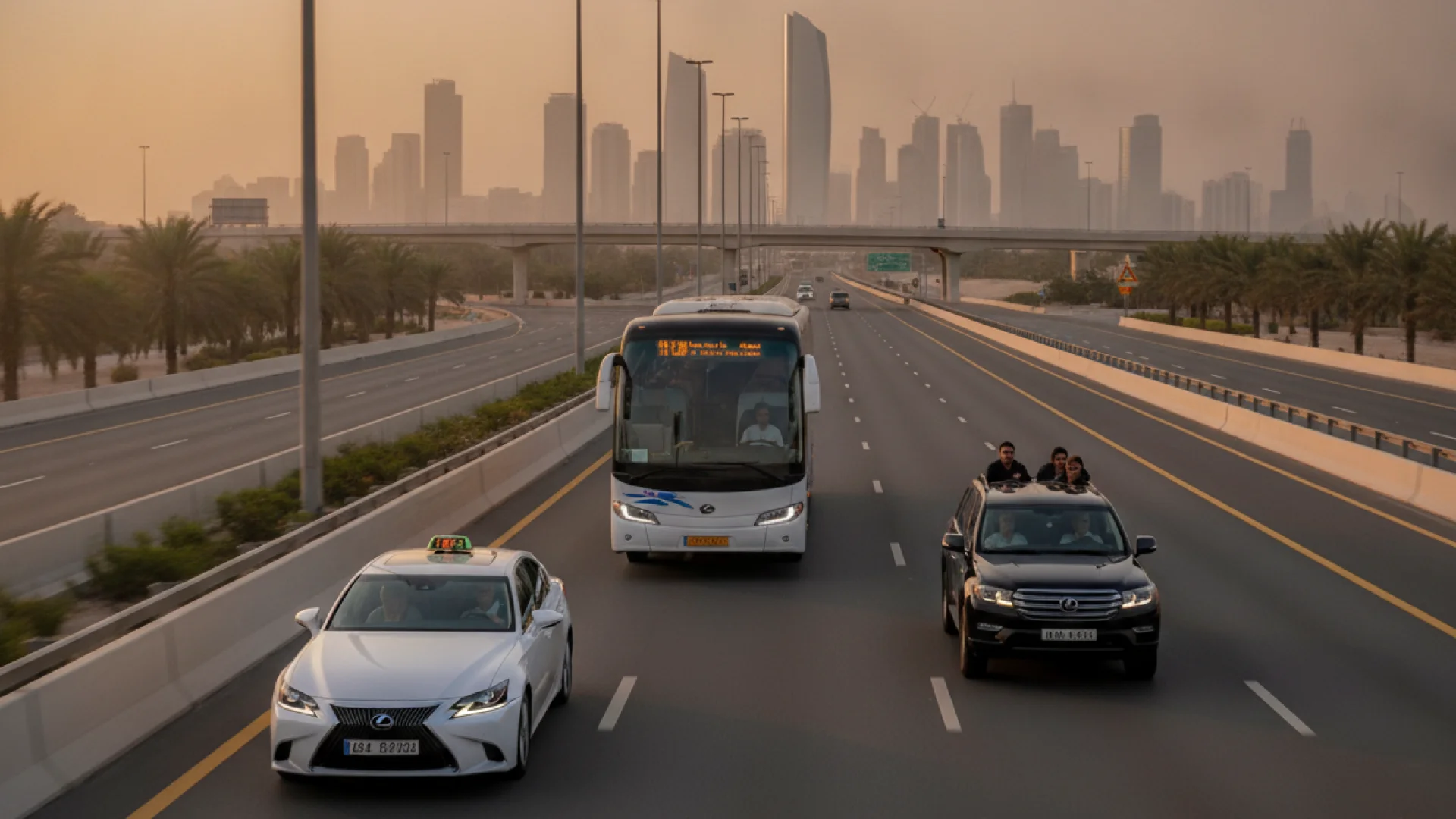
The run covers roughly 140 kilometers. Most drivers stick to the E11 (Sheikh Zayed Road), which is the most direct shot. If you hit nasty rush-hour bottlenecks near Jebel Ali, seasoned drivers often divert east toward the E311 (Sheikh Mohammed Bin Zayed Road) to keep moving, though it tacks on extra distance.
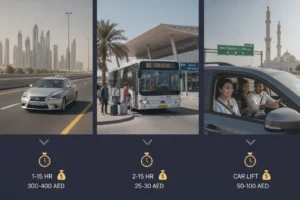
Here is how the real-world door-to-door numbers stack up:
| Transit Mode | Typical Travel Time | Estimated One-Way Cost | Best Suited For |
|---|---|---|---|
| Private Taxi / Cab | 75–90 mins | AED 250–350+ | Families, heavy bags, tight schedules |
| Public Intercity Bus | 120–150 mins | AED 25–35 | Solo travelers, strict budgets |
| Car Lift (Carpool) | 80–100 mins | AED 40–80 | Regular commuters traveling light |
Taking a metered Dubai to Abu Dhabi taxi service gives you total door-to-door freedom without the stress of parking, but you pay for the privilege. That fare covers dynamic road tolls—Dubai’s Salik gates and Abu Dhabi’s Darb system—alongside the cross-emirate surcharge.
Buses like the E100 or E101 run cheap via your Nol card, but keep realistic expectations. Once you factor in getting to Al Ghubaiba or Ibn Battuta station, waiting in queue, and taking a local cab from Abu Dhabi Central Bus Station to your final stop, your travel time easily doubles. Luggage is another dealbreaker: buses tuck standard suitcases underneath just fine, but hauling three oversized bags with kids in tow through a terminal is a fast track to burnout.
Taking a Dubai to Abu Dhabi Taxi Service: Pricing, Booking, and Comfort
Catching a cab between emirates is easily the most forgiving way to travel, especially if you have oversized luggage or zero patience for bus timetables. You can flag a beige metered cab right outside DXB Terminals 1, 2, or 3 at 2:00 AM, tap Hala Taxi inside the Careem app while finishing breakfast in Downtown Dubai, or book intercity trips directly through the official Dubai Taxi Corporation (DTC) app.
The fare comes down to simple math, though first-timers often get surprised by the inter-emirate jump. Metered rides track distance along the E11 or E311 highway, but the moment your cab passes the Seih Shuaib border line, the meter auto-adds a mandatory AED 20 cross-emirate boundary surcharge.
Here is what you can reasonably plan to spend depending on your wheels:
| Service Level | Typical Vehicle | Estimated Total (One-Way) | Best For |
|---|---|---|---|
| Standard Metered | Toyota Innova / Camry | AED 250 – AED 330 | Small families, 2–3 suitcases |
| Hala / DTC Van | Maxus / HiAce (6-seater) | AED 300 – AED 380 | Groups, bulky gear |
| Executive / Uber Black | Lexus ES / Mercedes E-Class | AED 450 – AED 600+ | Business trips, uninterrupted calls |
Tip: A ride straight to Yas Island sits on the lower end of that meter range (~AED 250), while heading all the way down to the Corniche or the Emirates Palace easily pushes past AED 320 due to city traffic.
The real value of using a private Dubai to Abu Dhabi taxi service lies in the control it gives you. You skip the chaotic bus station queues at Al Ghubaiba and dictate the journey. Need a quick bathroom break and a strong coffee at the Last Exit food truck park in Ghantoot? Just tell the driver.
A metered sedan is plenty comfortable for most, but if you have critical client meetings, booking an executive Lexus through Careem or Uber makes sense. You get silent cabin suspension, working phone chargers, leather seating, and drivers who know how to let you work in peace.
Riding the Intercity RTA Bus: Routes E100 vs E101 and Nol Card Rules
Taking the intercity bus is the cheapest way to cross emirates, but your overall travel time hinges entirely on which station you pick as your launchpad. Dubai runs two primary workhorse services down to Abu Dhabi Central Bus Station, and choosing the wrong one can easily add 45 minutes to your commute.
| Route | Origin Station | Best For | Typical Journey |
|---|---|---|---|
| E100 | Al Ghubaiba (Old Dubai) | Bur Dubai, Deira, Karama | 120–140 mins |
| E101 | Ibn Battuta (South Dubai) | Marina, JBR, Barsha, JLT | 85–100 mins |
The fare is a flat AED 25 per trip, but do not expect to pay cash to the driver or buy a paper ticket at the boarding queue. Boarding requires an RTA Nol card (Silver or Gold) with at least AED 25 in balance before you touch in. If your card drops to AED 24.50, the turnstile will reject you, forcing you to sprint to the ticket kiosk while your bus fills up.
Buses run roughly every 15 to 20 minutes during peak windows. However, practical travel time is rarely just the highway cruising limit. On Friday evenings or Sunday afternoons, lines at Ibn Battuta can snake out the door; you might wait through two full departures before boarding. Factor in the crawl around Abu Dhabi’s Shahama entry checkpoint, and your transit time creeps past two hours. If you are racing against a tight flight or hotel check-in, paying extra for a direct Dubai to Abu Dhabi taxi service avoids these terminal bottlenecks altogether.
Once settled inside, the experience is clean and utilitarian:
- Comfort & Seating: Strong A/C throughout, with forward rows strictly reserved for women and families.
- Connectivity: Free Wi-Fi is technically available, though streaming drops out frequently in desert dead zones along the E11.
- Luggage Limits: Regular suitcases go into the undercarriage bays without issue, but drivers routinely turn away passengers hauling trade boxes or oversized sports gear.
The Risks and Legal Realities of Using Informal Car Lifts in the UAE
If you have spent any time in local Facebook groups or classifieds, you have likely seen daily posts offering cheap seats between emirates. In the UAE, these unauthorized carpooling setups are known colloquially as car lifts. They are usually coordinated through private WhatsApp chats or social media by drivers looking to turn their personal saloon cars into off-the-books shuttles.
While saving 40 dirhams sounds appealing, the legal and safety realities are harsh. Under UAE Federal Traffic Law, transporting passengers for unmetered profit without a commercial permit is strictly illegal.
Transport authorities and police run targeted roadside stings along the E11 highway. If caught, the driver faces fines up to AED 3,000, 24 black points, and immediate vehicle impoundment.
As a passenger, the fallout goes beyond being stranded on a dusty shoulder near Ghantoot while the car gets loaded onto a recovery truck:
- Zero commercial insurance: Personal auto policies in the UAE contain commercial exclusion clauses. If your lift gets into a high-speed collision at 140 km/h, the insurer can—and usually will—deny passenger injury liability claims.
- Unvetted operators: You are sharing a confined space for 90 minutes with an unvetted driver whose sleep schedule, maintenance records, and driving history are complete unknowns.
- Trip abandonment: If an inspection checkpoint flags the vehicle, your luggage stays inside while officers process the seizure, leaving you to scramble for a costly roadside rescue.
| Transit Type | Legal Status | Typical Intercity Cost | Passenger Insurance? |
|---|---|---|---|
| Informal Car Lift | Illegal (subject to impound) | AED 30 – AED 60 | No (void on commercial use) |
| E101 / E102 Bus | Fully licensed (RTA) | AED 25 | Yes (government-backed) |
| Dubai to Abu Dhabi taxi service | Fully licensed (DTC / TransAD) | AED 250 – AED 350 | Yes (full commercial liability) |
If budget is tight, take the official RTA intercity coach from Ibn Battuta. If your schedule requires door-to-door comfort, book a licensed Dubai to Abu Dhabi taxi service or an authorized app like Careem. The upfront savings of an informal lift evaporate the moment you are standing on the highway waiting for a tow truck to clear your ride.
Real-World Commuter Case Studies: Tourists, Daily Workers, and Families
To see how the numbers and logistics play out in practice, let’s look at three typical traveler profiles on the E11 corridor.
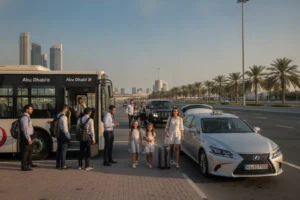
1. The Family Landing at DXB (4 Passengers + 4 Suitcases)
A family arriving after an eight-hour flight needs to get straight to their resort on Saadiyat Island.
Opting for the intercity bus means hauling luggage through DXB, catching the metro to Al Ghubaiba or Ibn Battuta, taking the bus to Abu Dhabi Central Station, and hailing a local cab for the final leg. By the end, they spend roughly AED 140–160 across four fares and four Nol cards, burning four hours.
Booking a standard Dubai to Abu Dhabi taxi service (an airport van or large sedan) costs roughly AED 300 to AED 380 door-to-door. At roughly AED 85 per head, the taxi eliminates three transfers and saves almost two hours of jetlagged frustration. For groups with bags, the taxi wins hands down.
2. The Daily Corporate Commuter (Dubai Marina to ADGM)
A consultant living near Dubai Marina commutes to Abu Dhabi Global Market on Al Maryah Island four days a week.
Hiring a daily private taxi run round-trip would run dry of AED 500 per day—financially unsustainable at AED 8,000+ monthly. Instead, this profile usually defaults to an informal car lift or buying a dedicated commuter car.
A monthly carpool share costs around AED 1,200 to AED 1,800, freeing them from the wheel to clear emails over the 75-minute drive each way.
3. The Solo Backpacker on a Shoestring
Traveling light with a 40-liter rucksack, a solo traveler has zero reason to book a cab.
Boarding the E101 bus at Ibn Battuta Metro Station costs AED 25 directly onto a Hafilat or Nol card, dropping them at Abu Dhabi Central Bus Station in about 90 minutes. It is clean, reliable, air-conditioned, and leaves enough cash for a Louvre Abu Dhabi ticket.
| Profile | Best Mode | Total Est. Cost | Door-to-Door Time |
|---|---|---|---|
| Family (4 pax + luggage) | Taxi / Van | AED 300–380 | 80–95 mins |
| Daily Worker (Solo) | Car Lift / Carpool | AED 60–90 / day | 75–90 mins |
| Solo Backpacker | E101/E102 Bus | AED 25 | 110–130 mins |
The Decision Rule
When deciding between private wheels and public transit, weigh these three variables:
- Party size: Once you hit three or four paying passengers, a taxi’s per-person cost drops close to the combined bus-and-metro fares.
- Baggage volume: Public buses restrict luggage space, and dragging multiple 23kg suitcases across metro platforms in midday heat is exhausting.
- Frequency: For single trips, pay for direct comfort; for recurring commutes, seek scheduled rideshares to protect your monthly budget.
Regulatory Standards and Official Guidance from RTA and ITC (E-E-A-T)
Hiring a cross-border ride isn’t just about finding the lowest fare; it comes down to who is legally permitted to carry you across emirate borders. Both Dubai’s Roads and Transport Authority (RTA) and Abu Dhabi’s Integrated Transport Centre (ITC) strictly regulate commercial transit. Booking a legitimate Dubai to Abu Dhabi taxi service means stepping into a vehicle operated by a driver with commercial licensing, continuous telematics tracking, and a clean criminal background check vetted by federal authorities.
Unofficial rides (often called car lifts or khorosi) cut corners on these checks. If police pull over an unlicensed private car operating as an illegal taxi on the highway, passengers face roadside impoundment delays, and the driver risks a fine starting at AED 3,000.

The E11 Highway Speed Rule
The moment you cross from Dubai into Abu Dhabi along the Sheikh Zayed Road (E11), the driving rules change fundamentally.
| Jurisdiction | Posted Speed Limit | Grace Buffer | Actual Radar Flash Point |
|---|---|---|---|
| Dubai (E11) | 100 or 120 km/h | +20 km/h grace margin | Flashes at 121 or 141 km/h |
| Abu Dhabi (E11) | 140 km/h | 0 km/h (Strict bufferless) | Flashes at 141 km/h |
Dubai applies a conventional 20 km/h speed buffer above the posted sign. Abu Dhabi eliminated its speed buffer entirely. Your driver must lock their cruise control precisely at or below 140 km/h the second you pass Ghantoot. Experienced taxi drivers adjust seamlessly; inexperienced private operators frequently misjudge the transition and brake erratically.
Where to Verify Fares and Disruptions
Never rely on hearsay for transit tariffs, especially during peak holidays when dynamic surcharge caps shift. Check these official touchpoints before traveling:
- Tariffs & Booking: Use the official S’hail app (RTA) or the Abu Dhabi Taxi app (ITC) to calculate base cross-border meter rates, which include standard inter-emirate toll charges (Salik and Darb).
- Live Disruptions: Monitor the verified X (formerly Twitter) channels of @RTA_Dubai and @ITCAbuDhabi for immediate fog-related lane closures or heavy weather diversions on the E11 and E311.
Decision Matrix: How to Choose Between Taxi, Bus, and Legal Rideshares
Choosing your ride down the E11 comes down to what you value most on the day: your dirhams or your minutes. If you are catching an afternoon meeting on Al Maryah Island or landing at DXB with three heavy suitcases, an official Dubai to Abu Dhabi taxi service wins every time. You get door-to-door comfort and shave off the extra connection times that eat up your morning.
On the flip side, solo travelers and backpackers should skip the private cab entirely. The intercity RTA buses (like the E101 from Ibn Battuta) cost around AED 25, run frequently, and give you clean, air-conditioned transit for a fraction of the price.
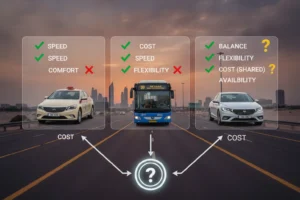
Here is how the legal options stack up side by side:
| Transit Mode | Average One-Way Cost | Travel Time | Best Suited For |
|---|---|---|---|
| Official Taxi / Hala | AED 250 – 350 | 75 – 90 mins | Families, luggage, time-sensitive trips |
| RTA Intercity Bus | ~AED 25 (via Nol) | 110 – 130 mins | Budget solo riders, light packers |
| Licensed Chauffeur (Uber/Careem) | AED 350 – 500+ | 75 – 90 mins | Executive comfort, pre-scheduled pickups |
Before heading out the door, run through a quick pre-trip checklist:
- Top up your Nol card: The intercity bus will not accept cash or standard credit cards at the gate. Make sure you have at least AED 30 loaded before joining the terminal queue.
- Watch the clock: Departing between 06:30 and 09:00 means hitting brutal outbound commuter traffic near JAFZA and the Dubai-Abu Dhabi border. If you must travel then, add 30 to 45 minutes to your ETA.
- Skip unlicensed “car lifts”: Informal rides promoted on social groups are illegal, heavily fined, and leave you entirely uninsured if an accident happens on the highway.
To keep things smooth, hail a cab curbside, book via the Careem app (selecting Hala Taxi for standard metered rates), or tap into the nearest major metro-bus hub at Ibn Battuta or Al Ghubaiba.
For Further information visit our Blog Page or Contact us on Whatsapp.