The Executive Commuter’s Reality
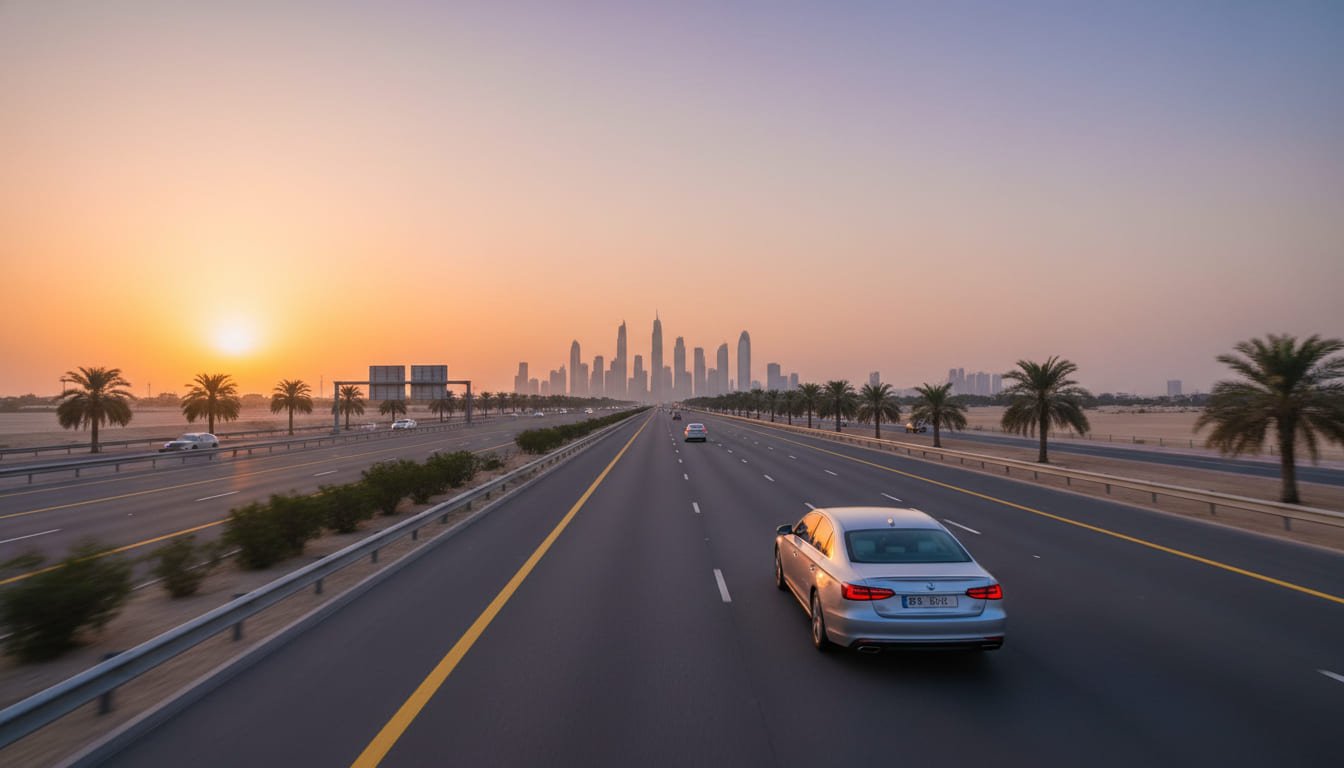
I distinctly remember sitting in gridlock near the Shahama toll gate last November. The dashboard clocked 44 degrees Celsius. The traffic stood paralyzed. I was auditing a mid-sized technology firm’s logistics budget, attempting to stem the bleeding from their corporate travel allowances. They were hemorrhaging capital on intercity transit. That afternoon, tracing the brake lights snaking toward the horizon, the sheer absurdity of the daily Dubai to Abu Dhabi migration crystallized in my mind. We accept astronomical depreciation, fuel consumption, and psychological fatigue as unalterable facts of corporate life. They are not. You can entirely restructure this overhead. Securing the cheapest car lift dubai to abu dhabi monthly is less about basic frugality and entirely about reclaiming thousands of dirhams and hundreds of hours annually.
Executive Summary: Cost Comparison Matrix
| Commute Modality | Average Monthly Cost (AED) | Hidden Liabilities | Time Recouped |
|---|---|---|---|
| Personal Vehicle (Sedan) | 3,800 – 4,500 | High depreciation, maintenance fatigue, Salik/Darb accumulation, collision risk. | Zero. Complete cognitive engagement required. |
| Corporate Fleet Service | 2,500 – 3,200 | Rigid schedules, lack of residential door-to-door flexibility. | High. Driver handles navigation. |
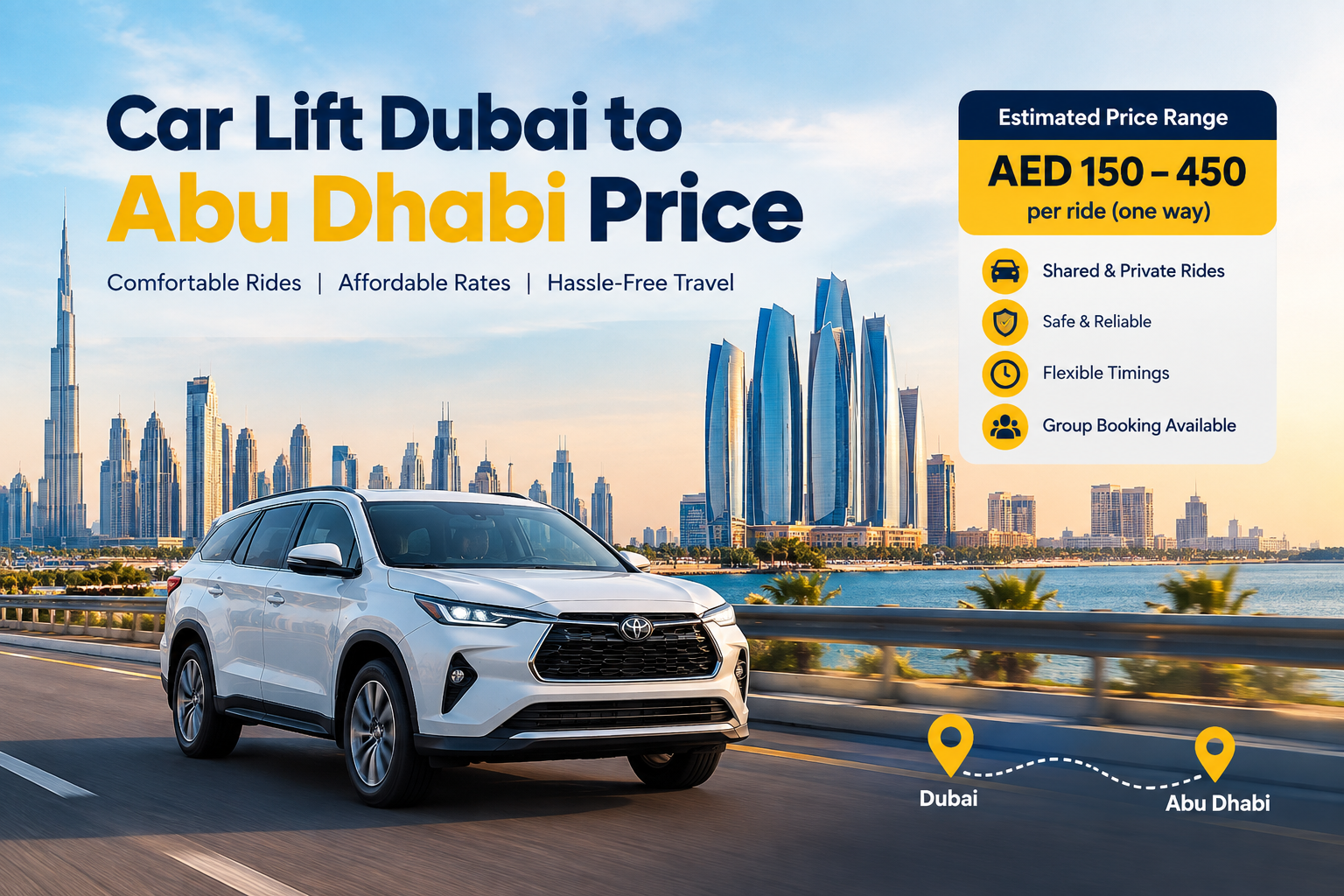
| Cheapest Car Lift Dubai to Abu Dhabi Monthly | 900 – 1,400 | Requires vetting for RTA compliance and vehicle redundancy. | Maximum. Sleep, work, or read en route. |
Numbers lack bias. The 140-kilometer stretch of the E11 highway acts as a silent tax on the regional workforce. If you drive a standard four-cylinder vehicle 280 kilometers daily for 22 working days, you accumulate 6,160 kilometers monthly. Your service indicator illuminates every six weeks. Your tires degrade at an accelerated pace. When you shift this burden to a managed passenger transport service, the economic paradigm flips.
Finding the Cheapest Car Lift Dubai to Abu Dhabi Monthly
Defining affordability requires nuance. Cheap, in the context of transport logistics, often masks deferred costs. I once watched an associate opt for a radically underpriced “grey market” minivan service run by an unlicensed operator. Two weeks into his contract, the vehicle broke down near Ghantoot. No replacement vehicle arrived. He missed a critical stakeholder presentation. True affordability is the intersection of low monthly premiums and ironclad operational reliability.
When you evaluate the budget monthly rideshare Dubai Abu Dhabi market, you must categorize operators by fleet architecture. Solo drivers operating private sedans represent the most fragmented tier. They offer high flexibility but zero redundancy. If the driver falls ill, your commute collapses. Conversely, organized commercial fleets leverage economies of scale. They pool commuter densities from specific hubs—like Discovery Gardens, Jumeirah Lake Towers, or Al Nahda—and route them systematically into Abu Dhabi’s commercial sectors, such as Al Maryah Island or the Corniche.
During my fleet audits, I scrutinized dozens of operators. Finding a functional balance led me to recommend established networks. For those serious about formalizing their commute, I consistently advise looking into Carlift Dubai Abu Dhabi, which structures their operations to absorb logistical friction while maintaining highly competitive subscription brackets. They manage the variables you cannot control: routing adjustments during fog advisories, toll management, and mechanical contingencies.
Legal Compliance: Avoiding the Grey Market Trap
The regulatory environment governing passenger transport in the United Arab Emirates is stringent, and rightfully so. Operating an unlicensed commercial passenger service carries severe financial penalties and potential vehicle impoundment. As a passenger, engaging with illegal operators exposes you to profound liability, particularly concerning insurance coverage during a traffic incident.
You must verify that your transport provider operates under the strict purview of the Roads and Transport Authority (RTA). Legitimate operators possess specific commercial licensing that mandates rigorous vehicle inspection protocols, passenger liability insurance, and professional driver certification. Furthermore, crossing the border into the capital means the fleet must align with the regulations enforced by the Integrated Transport Centre (ITC). The ITC monitors intercity bus and private hire movements meticulously. Do not risk your safety or your schedule on an unverified WhatsApp group organizer. Demand proof of commercial licensing before signing any monthly contract.
Cost Breakdown: Cheapest Car Lift Dubai to Abu Dhabi Monthly Versus Driving
Let us dissect the financial anatomy of this commute. We will build a conservative model based on a standard Japanese sedan. Fuel prices fluctuate, often influenced by regional fuel price fluctuations, but assuming an average of 3.00 AED per liter for Super 98, and an optimistic consumption rate of 8 liters per 100 kilometers, the math becomes grim. 6,160 kilometers requires roughly 492 liters. That is 1,476 AED purely in combustion.
Next, we calculate tolls. Salik gates in Dubai (Al Safa, Al Barsha) and Darb gates in Abu Dhabi create a daily financial drip. Assuming minimal gate crossings, estimate 300 AED monthly. Parking in Abu Dhabi’s central business districts? Add another 400 AED unless subsidized by your employer. We are now at 2,176 AED without addressing the elephant in the garage: depreciation.
Vehicle depreciation is not a theoretical concept; it is realized capital destruction. Adding over 70,000 kilometers annually to your odometer annihilates resale value. Using straight-line depreciation models, this easily equates to 1,500 AED in lost equity per month. Your total actual cost hovers around 3,676 AED. By contrast, locking in the cheapest car lift dubai to abu dhabi monthly limits your exposure to a flat fee—often between 900 and 1,200 AED. The resulting 2,400 AED surplus can be redirected into investments, savings, or elevated living standards. You are essentially giving yourself a tax-free raise.
Analyzing the Budget Monthly Rideshare Dubai Abu Dhabi Market
Vehicle configuration dictates pricing density. When you engage a service, you are leasing spatial real estate within a moving chassis. Understanding how operators structure this will help you negotiate better rates.
The Minivan Configuration (14-15 Seater)
This is the workhorse of the E11. Nissan Urvans and Toyota Hiaces dominate this tier. Because the operator can divide fuel and toll overhead across up to fourteen paying passengers, this represents the absolute floor in pricing. It is hyper-efficient. However, expect multiple pickup stops. The routing algorithms utilized by fleet managers attempt to cluster pickups, but you will inherently spend more time in transit. If raw cost reduction is your primary objective, this is your arena.
The Executive Van Configuration (7-9 Seater)
Vehicles like the Honda Odyssey or Kia Carnival sit in the middle tier. They offer substantial legroom, captain’s chairs, and superior suspension dynamics. The pricing scales up by roughly 20-30% compared to a high-capacity minibus, but the transit time shrinks dramatically. Fewer passengers mean fewer stops. This is the sweet spot for mid-level professionals who need to open a laptop and review spreadsheets without elbowing their neighbor.
The Sedan/SUV Pooling Configuration (3-4 Seater)
The premium tier of the budget market. Four executives sharing a Lexus SUV or a Toyota Previa. It mimics the experience of a private chauffeur but splits the cost quarterly. This tier rarely qualifies as the cheapest car lift dubai to abu dhabi monthly on paper, but when weighted against the sheer comfort and speed of point-to-point delivery, its value proposition is incredibly strong.
Securing an Affordable Monthly Carpool From Dubai to Abu Dhabi
Contract negotiation in this sector is highly informal but demands rigorous attention to detail. Never hand over a full month’s cash advance without establishing specific operational boundaries. I counsel my corporate clients to establish Service Level Agreements (SLAs), even for individual commuter contracts.
First, clarify the contingency protocol. Ask the operator directly: “If this specific vehicle suffers a catastrophic tire failure at 6:00 AM on the Sheikh Mohammed Bin Zayed Road, what is the precise mechanism and timeline for a rescue vehicle?” If they hesitate, walk away. Professional outfits maintain floating standby vehicles for this exact scenario.
Second, define the late policy. You need to know the grace period. If you are delayed by an elevator malfunction in your residential tower, will the driver wait three minutes or depart immediately to preserve the schedule for the other passengers? Conversely, if the driver is perpetually late, what is your financial recourse? A prorated refund mechanism must be established for operator-side failures.
Third, examine the cancellation architecture. Can you pause your subscription during your annual leave? Paying for thirty days when you are spending two weeks in Europe destroys the economic efficiency you worked so hard to establish. Premium operators offer highly modular billing cycles to accommodate expatriate travel patterns.
Evaluating the Cheapest Car Lift Dubai to Abu Dhabi Monthly Routes
The asphalt you traverse dictates your stress levels. Fleet operators typically utilize one of three primary arteries, each carrying distinct advantages and liabilities depending on the time of day and the geographical clustering of the passenger manifest.
The E11 (Sheikh Zayed Road / Sheikh Maktoum Bin Rashid Road)
The oldest and most direct route connecting the coastal hubs. If your pickup is in Dubai Marina, JBR, or Jebel Ali, and your drop-off is in Khalidiyah or the Corniche, the E11 is the mathematical default. However, it suffers from severe bottlenecking near the border and high radar density. Operators favoring this route prioritize proximity over continuous cruising speed.
The E311 (Sheikh Mohammed Bin Zayed Road)
Sitting further inland, the E311 offers an extra lane and a higher speed limit for heavy vehicles, easing the flow of smaller commercial vans. If your origin point is Silicon Oasis, International City, or Sports City, a competent driver will bypass the E11 entirely and utilize the E311. It generally provides a smoother, less chaotic transit experience, reducing the sudden braking that causes passenger motion sickness.
The E611 (Emirates Road)
The deep inland bypass. Rarely used for direct Abu Dhabi city commutes unless massive accidents paralyze the E11 and E311. However, if you are commuting from deep Dubai (like Al Qudra) to the outskirts of Abu Dhabi (like Baniyas or Khalifa City), the E611 operates as a high-speed, low-density conduit. Fleet dispatchers utilizing real-time GPS telemetry will reroute vans dynamically to the E611 to preserve SLA arrival times during heavy fog incidents.
Psychological Dividends of Outsourcing Your Commute
We routinely underestimate the cognitive load of hyper-vigilance. Driving at 140 km/h in dense, aggressive traffic requires a sustained release of cortisol and adrenaline. Your sympathetic nervous system is engaged continuously for nearly three hours daily. When you finally arrive at your desk, you are already operating at a physiological deficit.
Transitioning to the cheapest car lift dubai to abu dhabi monthly transforms a sterile, exhausting task into passive, usable time. This is where the concept of “Information Gain” truly applies to your lifestyle. Three hours a day translates to roughly 60 hours a month. What is the value of 60 uninterrupted hours? I have seen professionals use this recovered time to learn new languages, complete secondary degrees via mobile learning, or simply sleep, dramatically improving their performance metrics at work. You are not just saving money on brake pads; you are reclaiming a massive percentage of your conscious life.
Macro-Trends: The Future of UAE Intercity Transit
It would be myopic to discuss road logistics without acknowledging the imminent shift in UAE transport infrastructure. The Etihad Rail passenger network will eventually connect the emirates with high-speed rail, fundamentally altering the commuter landscape. However, rail systems operate on fixed lines. They require