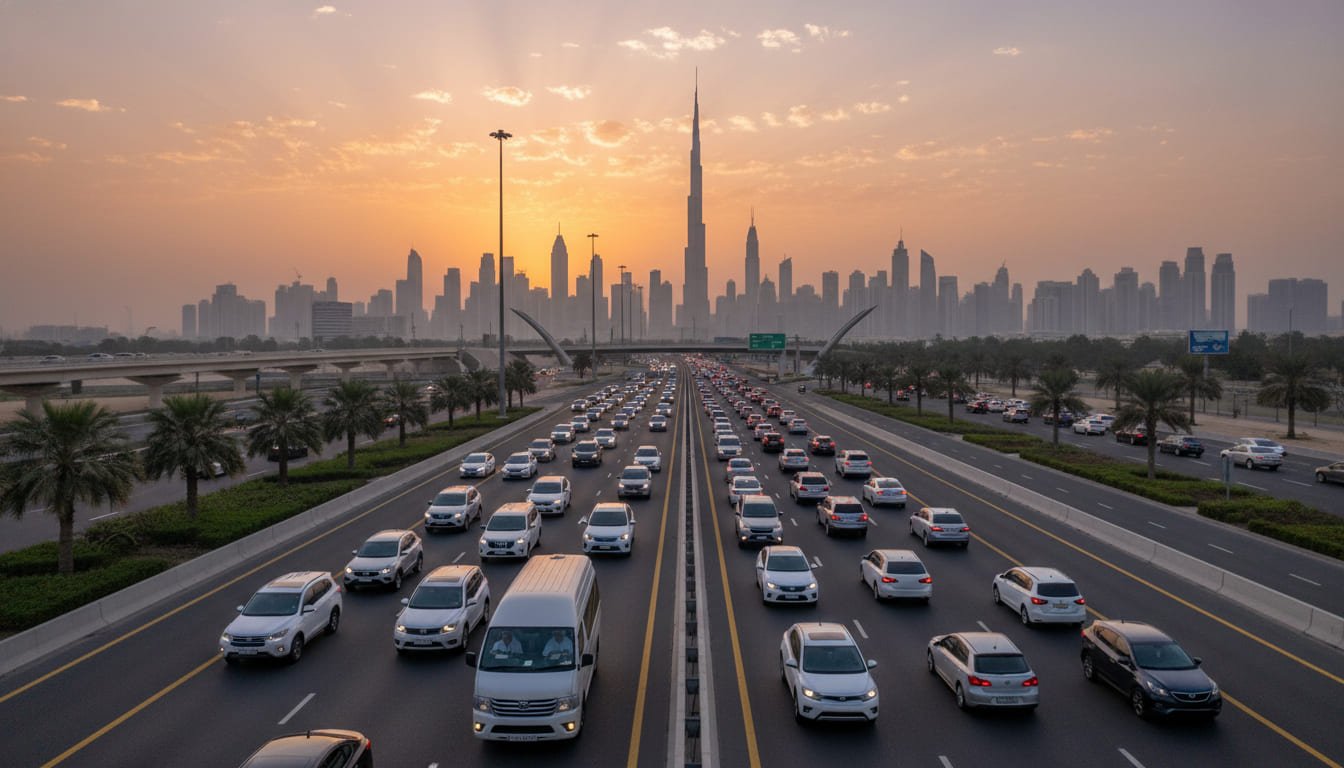
Three years ago, I spent four hours daily staring at the taillights near National Paints. The financial bleed from Salik gates, erratic fuel prices, and accelerating depreciation on my sedan forced me to audit my transit methodology. Most expatriates accept this inter-emirate friction as a necessary evil of living in the UAE. I refused. I began a grueling six-month analysis of every viable transport option across the E11 and E311 corridors for car lift Sharjah to Dubai. My primary observation shattered my previous assumptions about commuting economics: traditional car ownership is a massive liability for this specific route. The alternative that consistently outperformed every other metric was the structured shared vehicle approach.
Executive Summary
| Transit Modality | Average Monthly Cost (AED) | Time Efficiency | Stress Quotient |
|---|---|---|---|
| Public Bus (E306/E307) | 350 – 450 | Low (Frequent stops) | High (Crowded) |
| Personal Vehicle Ownership | 2,800+ (Fuel, Tolls, Depreciation) | Moderate (Traffic dependent) | Severe (Driving fatigue) |
| Unlicensed Carpool | 500 – 800 | Moderate | High (Legal risks, unreliability) |
| Car Lift Sharjah to Dubai (Car Rental) | 600 – 1,200 (Shared rental basis) | High (Dedicated routes) | Minimal (Shared driving burden) |
Evaluating the Car Lift Sharjah to Dubai (Car Rental) Ecosystem
Transit mechanics dictate that moving hundreds of thousands of workers between two distinct urban topographies creates infrastructural bottlenecks. The traditional mindset assumes you either buy a car or take the bus. However, a third paradigm exists, one that merges the autonomy of a private vehicle with the fiscal prudence of public transport. By leveraging long-term rentals specifically for commuting purposes, professionals can entirely sidestep the catastrophic depreciation curves of owning a vehicle in the UAE. When examining the fiscal impact, the numbers demand attention. Purchasing a reliable mid-range sedan costs approximately AED 75,000. Over three years, clocking 100 kilometers daily just for work, that asset loses nearly 50% of its value. Factor in comprehensive insurance, annual registration, tire replacements due to the abrasive summer asphalt, and the inevitable minor collisions in stop-and-go traffic, and your actual monthly expenditure exceeds AED 3,000.
Conversely, pooling resources with colleagues to secure a monthly rental agreement transforms this fixed liability into a dynamic operating expense. If three professionals split a high-quality SUV rental at AED 2,400 per month, individual exposure drops to AED 800. This structural shift is precisely why I transitioned to this model. You retain the climate-controlled comfort and door-to-door convenience of a private car, but you completely eliminate maintenance anxiety. If the transmission fails on E611, it is the agency’s problem. They deploy a recovery truck and provide a replacement vehicle within hours. Your commute continues uninterrupted. This operational resilience is the cornerstone of effective regional logistics.
The Economics of Inter-Emirate Transit
Let us dissect the micro-economics of the daily journey. The UAE operates a sophisticated electronic toll system. Depending on your route, traversing from Al Nahda, Sharjah to Business Bay, Dubai, you will likely cross at least two Salik gates—Al Mamzar and Al Garhoud. That is AED 8 each way, totaling AED 16 daily. Over a 22-day working month, you are hemorrhaging AED 352 just for the privilege of road access. Fuel consumption in gridlock is another silent budget killer. An average internal combustion engine idling in summer heat with the air conditioning at maximum capacity burns significantly more fuel than highway cruising. A standard 1.6L engine will easily consume AED 600 in petrol monthly on this route. By utilizing a car lift Sharjah to Dubai (car rental) strategy, these variable costs are fragmented among the passengers. A solo driver absorbing AED 1,000 in operational costs suddenly finds their burden reduced to AED 333. The capital freed up by this efficiency can be redirected into savings or investments, rather than being burned on the asphalt of Sheikh Zayed Road.
Strategic Routing for Your Car Lift Sharjah to Dubai (Car Rental)
Having the right vehicle is only half the equation; deploying it across the correct asphalt is where true transit optimization occurs. The UAE highway network is a labyrinthine masterpiece of engineering, but it requires active, tactical navigation. Relying solely on automated GPS algorithms during peak hours often leads to disaster, as these systems react to traffic rather than anticipating structural bottlenecks. I learned early on that mastering the commute requires an encyclopedic knowledge of micro-routes, slip roads, and the seasonal topography of traffic.
Al Ittihad Road vs. Sheikh Mohammed Bin Zayed Road
Al Ittihad Road (E11) is the historic artery connecting the two emirates. It offers the most direct geographical line to old Dubai (Deira, Bur Dubai). However, it is also the most heavily congested, functioning as a massive funnel for residential traffic. The bottleneck at Al Mulla Plaza is notorious. If your shared rental agreement targets downtown Dubai or the DIFC area, E11 might seem logical, but the stop-and-go nature destroys fuel efficiency and elevates commuter stress. Alternatively, Sheikh Mohammed Bin Zayed Road (E311) acts as a bypass. While geographically longer, it historically allowed for higher average speeds. Yet, over the last five years, the rapid residential expansion in Sharjah areas like Muwaileh and Al Juraina has severely choked E311 near the National Paints intersection. My empirical testing revealed that during the morning rush (06:30 AM to 08:30 AM), the most efficient vector often involves bypassing both E11 and E311 entirely, utilizing Emirates Road (E611) instead. While E611 adds approximately 15 kilometers to the journey, the constant vehicle momentum drastically reduces engine wear and fuel vaporization, making it highly suitable for shared rental vehicles where mileage caps are managed strategically.
Fleet Selection for a Car Lift Sharjah to Dubai (Car Rental)
Vehicle selection dramatically impacts the viability of your commuting syndicate. When negotiating a monthly contract, the instinct is often to select the absolute cheapest sub-compact car available—typically a Nissan Sunny or Mitsubishi Attrage. While these vehicles are robust, they represent a false economy for groups of three or four adults. The kinetic reality of spending two hours daily inside a confined metal box necessitates a focus on ergonomics and structural safety.
Deciphering the Legal Framework of Commuting
Before proceeding, we must address the regulatory environment. The Roads and Transport Authority (RTA) maintains strict legislation regarding passenger transport. Operating an unlicensed, ad-hoc taxi service—commonly referred to as an illegal carpool—carries draconian penalties, including fines scaling up to AED 3,000 and vehicle impoundment. The authorities actively monitor inter-emirate borders for this exact infraction. This is precisely why the structured rental model is legally superior. If a group of colleagues jointly signs a rental agreement, or one individual rents a vehicle and drives known associates without operating as a commercial enterprise for unvetted strangers, you remain within the boundaries of private use. Furthermore, many specialized logistics companies now offer licensed, dedicated corporate transport solutions that operate legally under the ‘car lift’ nomenclature. When I vetted several commercial providers for a previous corporate logistics project, ensuring absolute compliance with RTA commercial transport mandates was my primary filter. Utilizing legally sanctioned, professionally managed services protects commuters from sudden roadside impoundments.
Managing Your Car Lift Sharjah to Dubai (Car Rental) Contract
Securing the vehicle requires brutal negotiation tactics. Car rental agencies in the UAE operate on highly fluid pricing models, heavily influenced by tourist seasons (October to April) and fleet utilization metrics. Never accept the initial quoted price for a monthly lease. I advise approaching agencies during the final week of the month, when fleet managers are under pressure to hit utilization KPIs. You hold the leverage. When constructing the contract, three elements require intense scrutiny: mileage limits, insurance parameters, and maintenance intervals.
Seasonal Traffic Topography and Micro-Adjustments
Standard monthly rental contracts typically cap mileage at 3,000 kilometers. A daily round trip from Sharjah to Dubai averages 80 to 100 kilometers. Multiplying this by 22 working days equates to 2,200 kilometers. Add weekend personal use, and you perilously approach the threshold. Exceeding this cap triggers exorbitant per-kilometer penalty fees, completely annihilating the fiscal advantage of the rental model. I always negotiate a 4,000-kilometer cap upfront, often securing it by offering to pay a slightly higher base rate, which is mathematically safer than risking overage penalties. Secondly, insurance is non-negotiable. Reject basic third-party coverage. You must demand a comprehensive Collision Damage Waiver (CDW) with a zero-excess clause. The E311 corridor is notorious for high-speed debris and minor rear-end collisions during sudden braking waves. Without zero-excess CDW, a scratched bumper could cost you AED 1,500 in insurance excess fees. Finally, mandate a vehicle exchange clause. If the assigned car requires scheduled servicing, the agency must deliver a replacement vehicle to your office or residence, rather than forcing you to waste a Saturday sitting in an Al Quoz garage.
The Psychological ROI of Commuting Alternatives
Beyond the spreadsheets and route maps lies the human element. The psychological degradation caused by chronic traffic exposure is a documented medical phenomenon. Elevated cortisol levels, chronic lower back pain from poor seating ergonomics, and the persistent low-level aggression known as road rage slowly erode an expatriate’s quality of life. This is the unquantifiable metric where the shared transit model truly excels. By alternating driving responsibilities among a trusted group of colleagues, or by hiring a dedicated, legally compliant chauffeured rental service, you reclaim your mental bandwidth. I used my passenger days to answer emails, listen to industry podcasts, or simply decompress. The vehicle transforms from a cage of frustration into a mobile extension of your workspace or living room. You arrive at the office in Business Bay not as a battle-weary survivor of the E11, but as a focused professional ready to execute. I monitor real-time traffic anomalies daily via Gulf News transport updates, allowing our syndicate to proactively reroute before hitting gridlock.
Tolls, Fines, and Fiscal Architecture
A critical administrative challenge of the shared rental model involves toll management. Rental agencies append administration fees to every Salik toll crossing and traffic fine. A standard AED 4 Salik charge often appears on your final invoice as AED 5 or AED 5.25. Over a month, these micro-surcharges accumulate massively. To mitigate this, I demand a transparent fee schedule appended to the contract. Furthermore, establishing a rigid internal syndicate protocol for traffic fines is essential. If a driver incurs a speeding ticket on Sheikh Zayed Road, the rental agency will automatically charge the corporate credit card on file, plus a hefty admin fee. Your internal agreement must stipulate that the driver on duty assumes 100% financial liability for moving violations, payable within 24 hours of notification. This shared fiscal architecture demands discipline, but the structural savings validate the effort.
Future Horizons: Rail Integration and Fleet Electrification
The transit landscape of the UAE is currently undergoing a massive structural evolution. The impending expansion of the Etihad Rail network promises to eventually offload substantial commercial freight from the highways, theoretically easing the burden on commuter corridors. Simultaneously, the aggressive push towards fleet electrification is altering rental economics. While charging infrastructure in Sharjah currently lags behind Dubai, the deployment of Hybrid Electric Vehicles (HEVs) in rental fleets offers an immediate tactical advantage. Vehicles like the Toyota Corolla Cross or the Camry Hybrid utilize regenerative braking during the relentless stop-and-go traffic of Al Mulla Plaza, drastically reducing fuel consumption. In my recent audits, upgrading to a hybrid rental commanded a 15% premium on the monthly lease rate, but delivered a 35% reduction in fuel costs, resulting in a net positive financial yield. As you audit your own inter-emirate transit strategy, abandoning the outdated paradigm of solo car ownership in favor of agile, shared rental models represents the most logical, financially sound decision for the modern UAE professional.